
My colleague M likes to ask provocative questions. At lunch, she might ask “How would you redesign the NHS?” or “What would you change in the tax code?” Despite what you might think, she is actually a fun person to be around. Never short of things to say and often the centre of any team building events.
We both work at an EdTech company. One of the questions she asks the most often is “how can we make this more fun?” And she is right. We work with academics and subject matter experts in weighty fields like “leadership”, “sustainability” and “data”. The default is towards seriousness. But does it have to be?
Over the weekend, I listened to strategist Bridget Angear on Adam Morgan’s Let’s Make This More Interesting podcast. The episode was about the business case for humour. Bridget’s research shows we know humour can be really effective in the workplace, but we’re all a bit scared to try and be funny.
It can feel like serious, purpose-diven work has led to the death of humour. Bridget’s research suggests brands using humour out-perform those non-funny ones by an order of double.
Humour is a way to make things more memorable. Humour stimulates a dopamine hit. It helps people remember things. We don’t remember what people tell us, we remember how they make us feel. It turns out this is true in education, in business, in entertainment. You might say, in all parts of life.
If you look at educators like Michael Rosen and Neil Postman, they argue for a similar cause. The dismissal of humour as unimportant dates back to the Reformation, said Rosen, “when they thought the only way you could be virtuous was to be modest and serious, so humour was pushed aside, seen as frivolous … even dangerous. And that seeps through into education today, so there’s a slight fear of subversiveness or laughter, as well as a dismissal of it. And for some of us, humour is a means of survival.”
If you think about interesting and important on a 2×2 you’d get something like this:
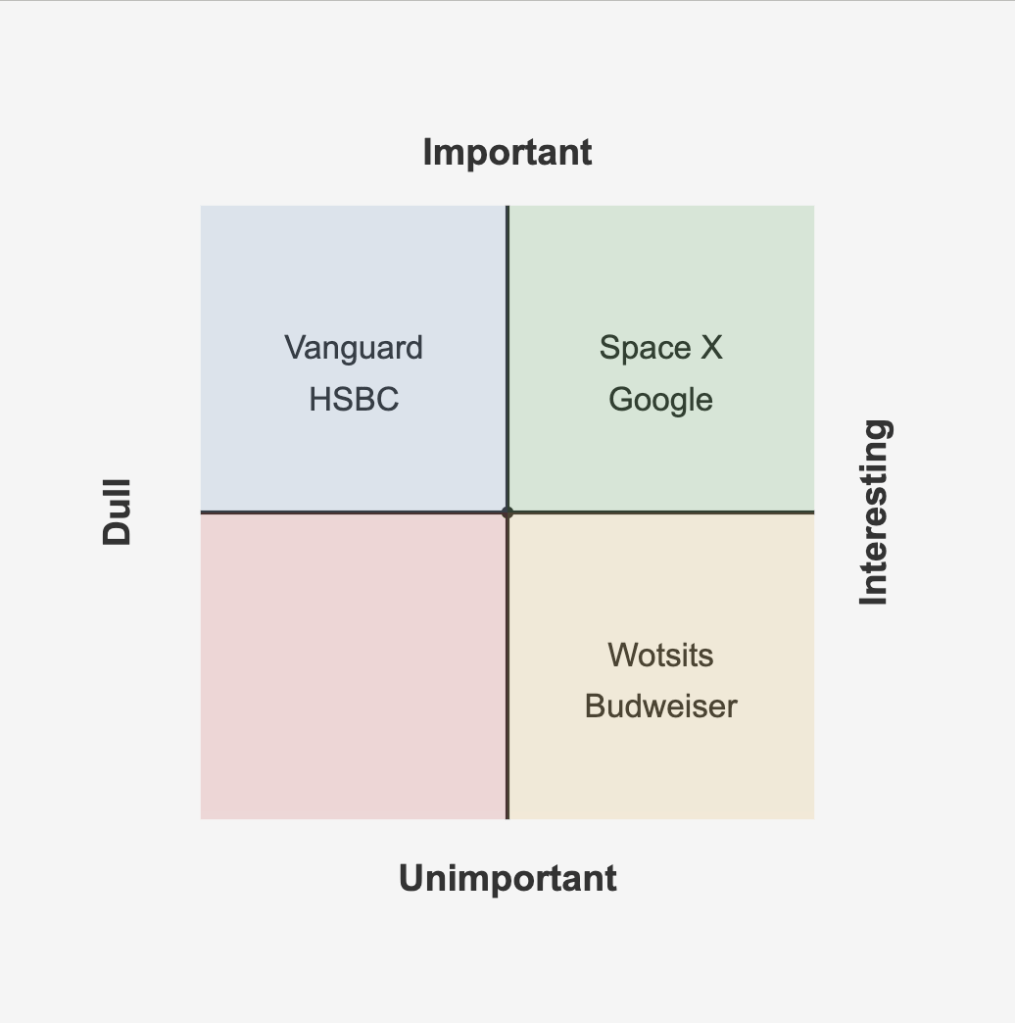
I’d argue nothing is unimportant and dull. Even traditionally “dull” things like tax software and steel girders are, in reality, extremely important.
The role of behaviour change. Although the interview is focused on advertising. As educators, there is a key role for humour in behaviour change.
Humour leaves a gap between the message and how you receive it. Think about a good one-liner, or a visual gag like the one from Arrested Development at the top of this post.
The connection your brain makes between the setup and the payoff creates new neural pathways in your brain. It helps you to remember.
I was going to sail around the globe in the world’s smallest ship but I bottled it. – Mark Simmons
Education is often reluctant to use humour. In this regard, it is similar to other po-faced categories like car manufacturers, premium and luxury, and the B2B world.
If you are talking to someone in a professional capacity, you often feel like you have to be serious. You can’t be frivolous. Although this last one is changing, slowly. For example, Workday’s “Rock Star” campaign.
Even though you are selling software to organisations, you can make it fun and joyful. It stands out. As most SaaS companies just tell you what their software does.
Bridget suggests three reasons for the increase in work seriousness. Firstly, the rise of purposeful brand communications (improve the planet or people) means brands tend to show up in a more serious way.
Secondly, in challenging economic times, brands are reluctant to use humour because they feel they are at risk of being tone-deaf.
Thirdly, brands are afraid of humour. A few years ago, Oracle interviewed 12,000 consumers and 3,000 marketers. They found 91% of consumers appreciate brands using humour. And 95% of brands said they feared using humour.
There is a risk to humour, if you get it wrong. So it’s easier to play it safe. If you use humour, it has to be funny.
When I reflect on a lot of EdTech companies, I see the same death of humour. The importance of fun and playfulness in a company’s culture is often overlooked. When I think about the most impactful workplaces I have been part of, fun and playfulness was a key aspect to creating psychological safety.
In a tougher economic climate, with procurement squeezing L&D budgets, and in the midst of a harsh layoff season, humour gets cast aside.
Four types of humour:
- Affiliation. Banter, messing around with your mates in the pub, gentle ribbing. Taking an insight and creating a bond.
- Self-enhancing. Tackling difficult topics, gallows / dark humour.
- Aggressive. Teasing, put-downs. Laughing at.
- Self-deprecating. At your own expense, laughing at yourself. Subtle, witty.
I’m going to keep exploring this theme. More to come. As Peter Ustinov said “comedy is just a funny way of being serious.”
 Gordon MacRae Blog
Leave a comment