Andrej Karpathy has a rebuttal to the idea of humour in learning. His perspective is anything short-form, bite-sized, and (yes) funny is entertainment, not learning.
I’m not going to use the word “edutainment” here because let’s give ourselves a break. It’s a horrible word. But it is what he’s talking about.
Karpathy says,
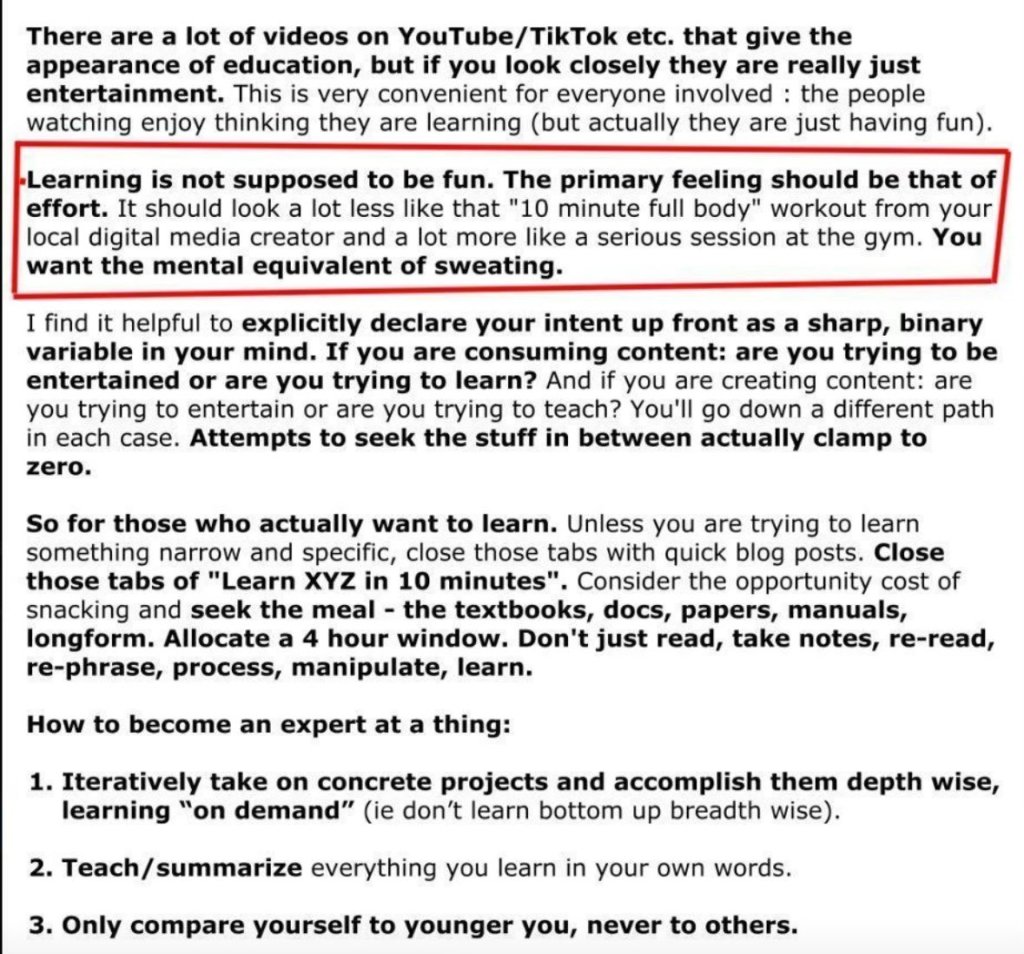
There are a lot of videos on YouTube/TikTok etc. that give the appearance of education, but if you look closely they are really just entertainment. This is very convenient for everyone involved : the people watching enjoy thinking they are learning (but actually they are just having fun). The people creating this content also enjoy it because fun has a much larger audience, fame and revenue. But as far as learning goes, this is a trap. This content is an epsilon away from watching the Bachelorette. It’s like snacking on those “Garden Veggie Straws”, which feel like you’re eating healthy vegetables until you look at the ingredients.
His take is learning is not supposed to be fun. Although it does not have to be actively not fun either. But the primary feeling you should have is one of effort.
If you are consuming content: are you trying to be entertained or are you trying to learn? And if you are creating content: are you trying to entertain or are you trying to teach? You’ll go down a different path in each case. Attempts to seek the stuff in between actually clamp to zero.
I don’t disagree with some of this. Particularly the depth required for learning something new.
Allocate a 4 hour window. Don’t just read, take notes, re-read, re-phrase, process, manipulate, learn. And for those actually trying to educate, please consider writing/recording longform, designed for someone to get “sweaty”, especially in today’s era of quantity over quality. Give someone a real workout.
But it does play up to the “grindset mindset” you see as the backbone to a lot of knowledge work. Or what we might call “email, spreadsheet and deck-building” jobs.
“Knowledge work” is just a fancy layer we’ve added. We all basically work in a typing pool these days anyway.
This type of mindset is fine for someone in their 20s. For whom status is an important motivator. It also presents well on X and other grindset social media.
Part of what I struggle with at work is feeling guilty for not having this mindset. I work in an environment full of it. It’s exhausting putting on a mask everyday and pretending to belong.
Is it more powerful to treat your career as a joke than to be prissy and protective of it? This question nags at me. Does work provide us with meaning, should it provide us with meaning? Or do we, as people, seek out meaning behind all our actions (work, family, kids, community). Is it all a mask we present to the world?
We’re trained to believe in paths. Clear, well-marked trails that lead to predetermined destinations: career success, romantic partnerships, financial stability, and eventually, the mythical state of “having it all.” But what happens when these paths take us somewhere else?
I gave up writing when I was 22 to build a career and earn money. But now I want to get back to it. I’ve been denying this part of myself.
We often abandon the things that bring us genuine satisfaction for the things that bring us social validation, only to discover years later that we’ve traded authenticity for approval.
 Gordon MacRae Blog
Leave a comment